

SeedRouter
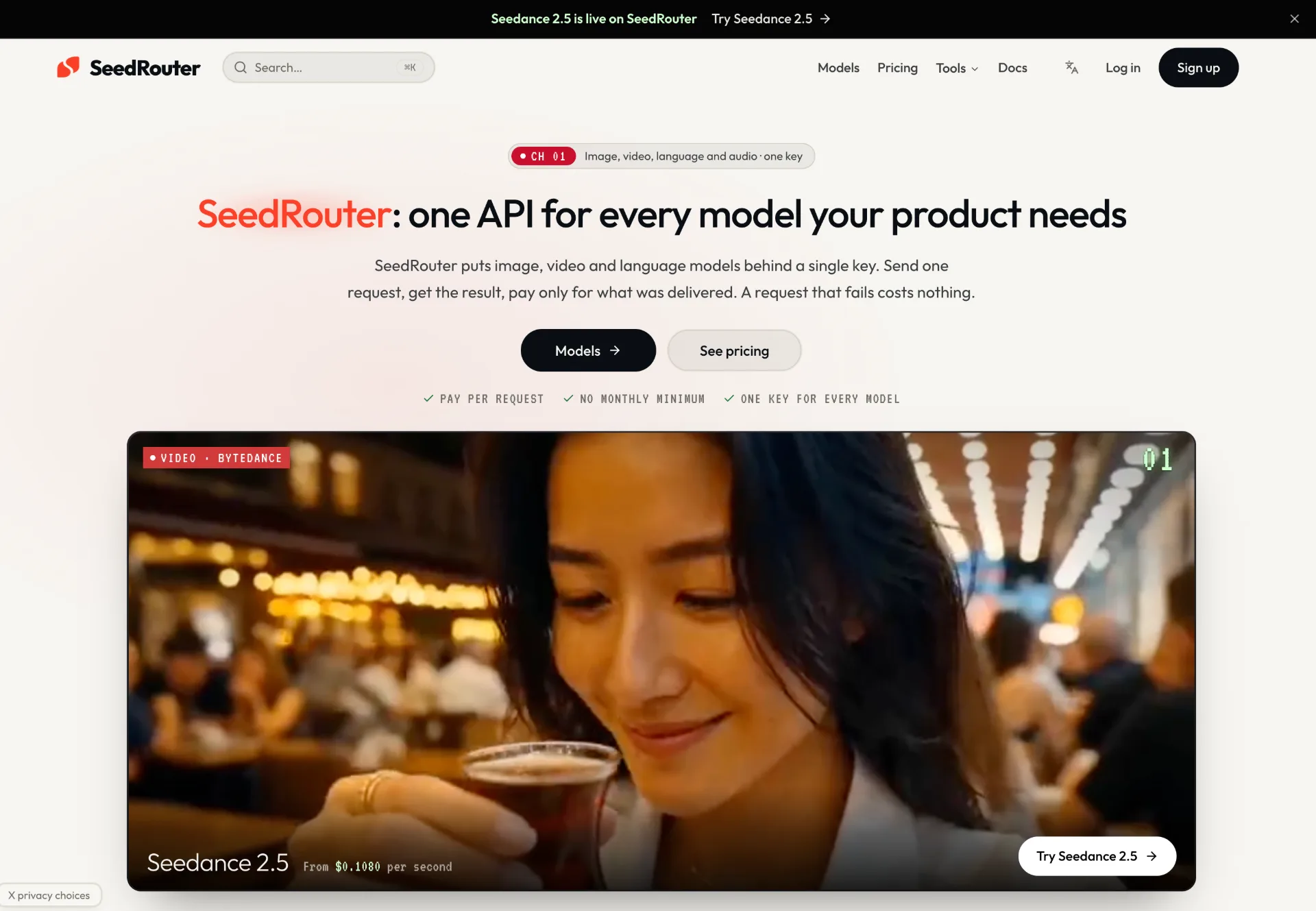
SeedRouter offers a single, pay-per-request API key to access image, video, language and audio models from providers like OpenAI, Anthropic, Google, Meta and more, with transparent pricing and one production-ready dashboard.
What is SeedRouter
SeedRouter is a unified AI infrastructure platform that puts image, video, language and audio models behind one API key. Instead of managing separate accounts, credentials and invoices for each vendor, you connect to SeedRouter once and call models from OpenAI, Anthropic, Google, Meta, ByteDance, Kuaishou and others through a consistent request shape, predictable billing, and a single dashboard built for production use.
How to use SeedRouter
-
Sign up for a SeedRouter account
Visit the SeedRouter website and create an account. The sign-up flow takes under a minute and lets you explore models, pricing and docs before you add any balance. -
Create your API key in the dashboard
After logging in, open the dashboard and generate an API key. This one key works across every image, video, LLM and audio model on SeedRouter, and you can manage or revoke keys at any time for security. -
Top up your balance in USD
Add funds to your SeedRouter balance in USD. Your balance is shared across all models and only charged per delivered request, with no subscription or monthly minimums. Failed requests cost nothing. -
Choose the right model from the catalog
Browse the Models page to find the provider and capability you need—such as GPT Image 2.5, Claude Opus 5.5, Gemini 3.1 Pro, Seedance 2.5, Muse Video, or Whisper-1. Review each model’s live starting price, parameters, and documentation before integrating. -
Select your integration path (LLM vs task API)
For language models, use the OpenAI-compatible endpoint so existing OpenAI SDK integrations can switch over by changing the base URL and API key. For image, video and audio models, use the SeedRouter task API, which returns a task ID for longer-running jobs. -
Implement your first API call
In your application code, replace the previous provider’s base URL with SeedRouter’s and set the Authorization header to your SeedRouter API key. For example, callPOST /v1/images/generationsfor image generation or the OpenAI-compatible/v1/chat/completionsfor LLMs, specifying themodelfield with the chosen model name. -
Handle async jobs with task IDs or webhooks
For video and long image or audio jobs, read thetask_idfrom the initial response. Poll the task endpoint forstatusandprogress, or register a webhook URL to receive a callback with a CDN link to the output when the job finishes. -
Monitor usage and costs in the dashboard
Use the unified dashboard to track every request, its model, status and exact price in real time. See cost per request, balance history, keys, and usage across all models so you can audit spend and optimize workflows. -
Scale and switch models without rewriting your stack
As your needs evolve, swap models—such as moving from one video family to another or switching between GPT, Claude and Gemini—while keeping the same request shape. SeedRouter abstracts vendor differences so you can iterate on quality, speed and cost with minimal code changes.
SeedRouter's use case
-
Product and advertising visuals
Generate campaign-ready product images and videos using references, consistent characters and brand-safe composition. Creative teams can explore multiple variants, review them, and control revision costs across different image and video models. -
AI comic and serialized content production
Connect scripts, character references and reusable shots to build comic panels or episodic stories. SeedRouter’s image and video models help creators maintain style and continuity while iterating quickly on scenes and sequences. -
Video production workflows
Build shot-based pipelines that generate, edit and extend clips with clear acceptance criteria and per-shot budgeting. Use keyframes, reference media and native audio where available to assemble sequences within a controlled spend. -
Ecommerce operations and catalog management
Create product copy, marketing descriptions and on-brand visuals from approved product data. Merchandising and growth teams can standardize content quality while keeping full visibility into token and media costs per item or campaign. -
Invoice and document extraction
Use language models to extract fields, line items, totals and evidence from invoices and other documents, then validate the parsed data before it enters financial or operational systems. -
Internal knowledge assistants
Build internal chat and retrieval-augmented applications that answer questions based on your company’s documents. SeedRouter’s LLMs can generate answers grounded in retrieved passages, technical terminology and traceable sources. -
Multimodal creative tools and consumer apps
Power end-user apps that let people generate images, videos, songs or dialogue from text, references or uploaded media, while routing requests through different model families based on user tiers, latency or price targets. -
Prototyping and model benchmarking
Quickly compare models from multiple vendors on the same prompts, media and tasks. Teams can test quality, speed and price trade-offs using unified APIs and per-request billing before committing to a production setup.
Benefits of SeedRouter
-
Unified access to leading AI models
SeedRouter aggregates image, video, language and audio models from major providers into one API. This lets teams experiment with GPT, Claude, Gemini, Seedance, Muse, Kling, PixVerse and more without juggling separate integrations and contracts. -
Transparent, pay-per-request pricing
Every supported model lists its cost per request—per second of video, per image, per token, or per job—so you know the price before you call. Billing happens only when output is delivered, with no charges for failed requests and no monthly minimums. -
Production-ready async and webhook workflow
Long-running jobs like video generation return a task ID, which you can poll or receive via webhook. Outputs are delivered as CDN links, making it straightforward to plug into pipelines, review tools, or consumer-facing products. -
Single dashboard for observability and control
A unified dashboard shows balance, keys, usage and per-request pricing across every model. This makes it easier to audit spend, debug production issues, and maintain compliance compared to managing multiple vendor consoles. -
Minimal integration friction and vendor lock-in
With an OpenAI-compatible endpoint for language models and a consistent task API for media models, you can swap model families or add new ones without rewriting your stack. This reduces lock-in risk and keeps your product flexible as the model ecosystem evolves. -
Built for real-world reliability
SeedRouter is designed around API paths, model docs and operational guarantees rather than demos. Clear error handling, no-charge failed requests, and predictable behaviour across models make it suitable for high-volume production traffic. -
Scalable across products, teams and industries
The same integration can support ecommerce, marketing, film, gaming, education, logistics and more, letting organizations consolidate AI usage behind a single platform with shared governance and budgeting.
Pros
- Centralizes access to many top AI models through one API key and dashboard.
- Clear, transparent pricing per model and per request, with no subscription or monthly minimum.
- OpenAI-compatible endpoint for LLMs and a consistent task API simplify integration and model switching.
- Async task handling with webhooks and CDN delivery suits long-running video and audio jobs.
- Designed specifically for production use, with detailed per-request billing and observability.
Cons
- Requires maintaining a prepaid USD balance instead of paying each vendor directly on invoice.
- Model selection is limited to those supported by SeedRouter, which may lag behind very new releases.
- Abstracted interfaces may hide certain niche or experimental features offered only in native vendor APIs.
- Teams with deep existing direct integrations might need migration work to fully adopt SeedRouter.
- Dependence on a single intermediary adds another operational layer to monitor for uptime and latency.
Help more people discover your product.
Submit to SubmitoMore to discover
Wan API
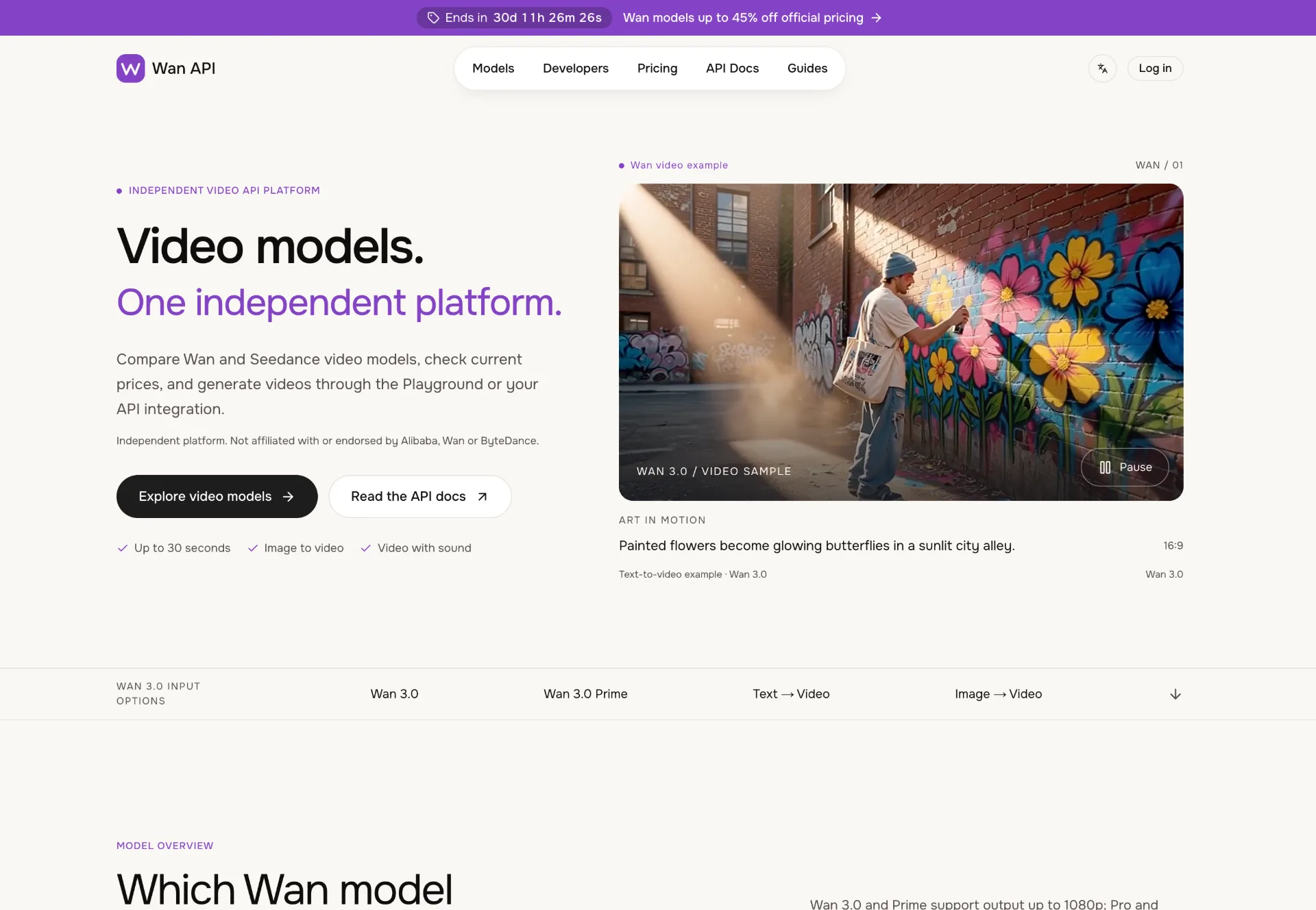
Discover Wan 3.0 video models on Wan API, turn text, images and multimodal references into 1080p–4K clips with generated sound, transparent pricing and a unified playground and API.

JuJuBit
JuJuBit lets you turn photos, sketches and character concepts into custom 3D printed figurines, TRPG miniatures and art toys with fast AI previews, hand‑refined models and worldwide shipping.
seedance 3.0
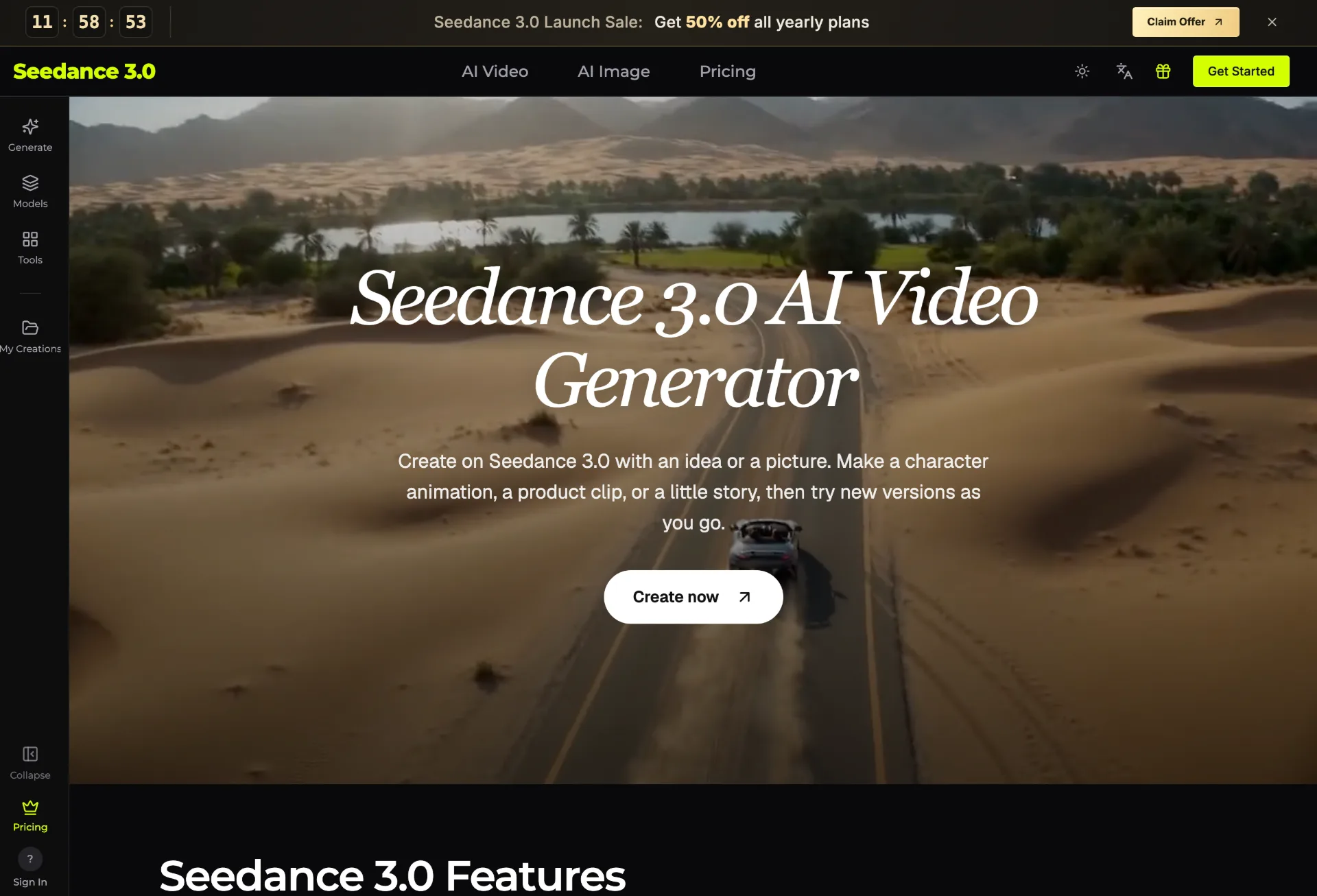
Seedance 3.0 is an AI video generator that transforms your text, images, clips, and audio into polished, editable videos for creators, marketers, teachers, and small businesses in just a few guided steps.