

TTAPI
Discover how TTAPI unifies Midjourney, Suno, Flux, and leading LLMs under one API key and prepaid balance. Explore features, pricing, and alternatives.
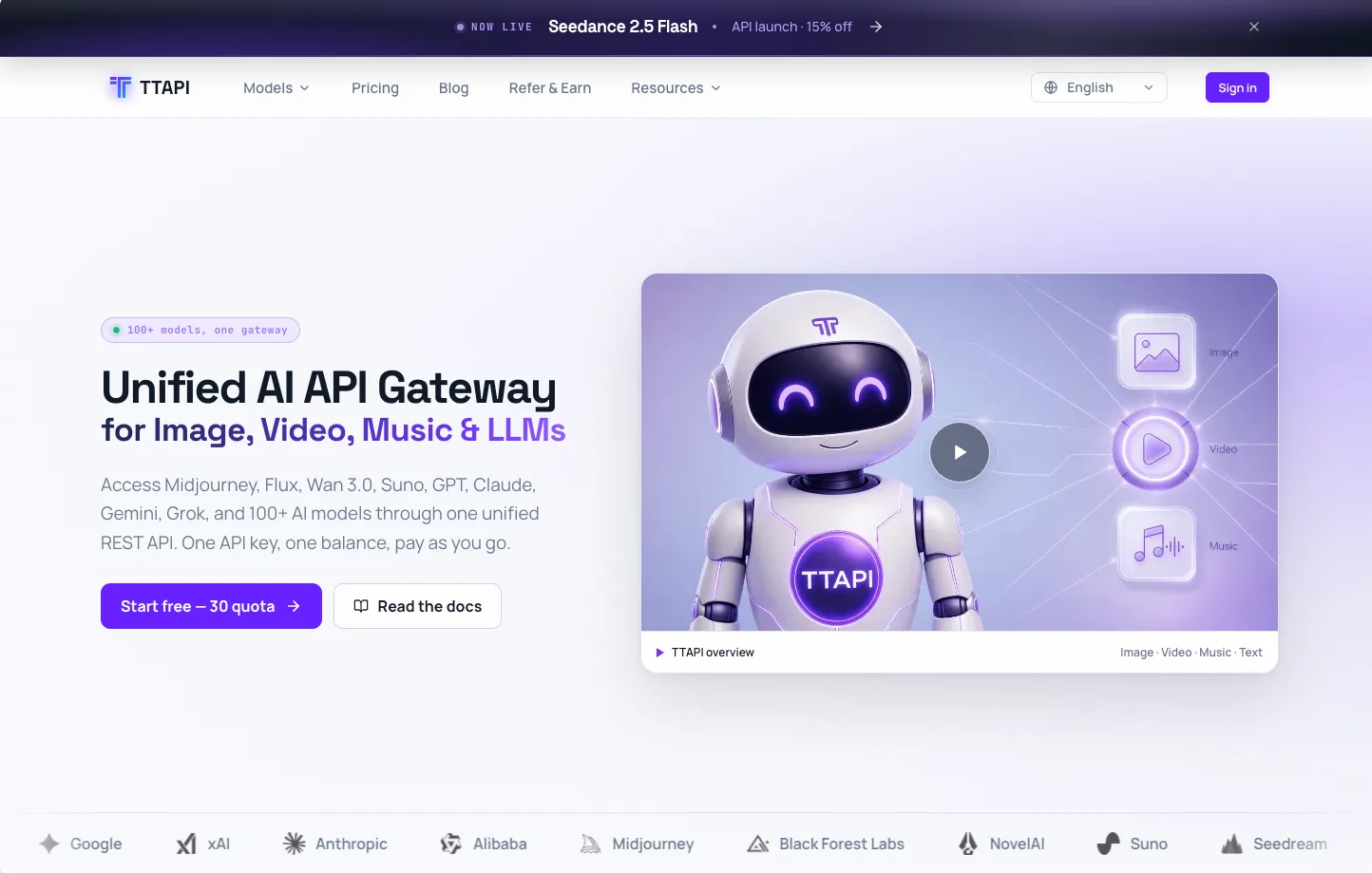
TL;DR: TTAPI is a unified REST API gateway that connects developers to over 100 generative AI models across image, video, music, and text modalities using a single API key and prepaid quota balance. It eliminates the engineering and administrative overhead of managing separate vendor accounts, distinct billing cycles, and inconsistent polling architectures. It is built primarily for indie makers, SaaS builders, and automation engineers who want to ship multi-modal AI features quickly without vendor lock-in.
What is TTAPI & How Does It Work?
TTAPI acts as an aggregation and routing layer sitting between your application and upstream generative AI providers, including OpenAI, Anthropic, Google, xAI, Midjourney, Black Forest Labs, Suno, Seedream, Seedance, and NovelAI. Instead of signing up for a dozen developer consoles, verifying multiple payment methods, and maintaining separate SDKs for every media type, developers authenticate once using a TT-API-KEY. All usage draws down from a centralized prepaid quota pool, consolidating multi-vendor infrastructure into one predictable HTTP interface and a single invoice.
Under the hood, TTAPI standardizes how long-running media generation tasks behave in production. While text models operate through an OpenAI-compatible LLM endpoint, computationally heavy tasks—such as rendering Midjourney visuals, generating Suno audio tracks, or synthesizing video clips with Veo and Wan—follow a consistent asynchronous job workflow. When your backend submits a generation request, TTAPI immediately returns a jobId. Your application can then either poll a free Fetch endpoint or pass a hookUrl parameter to receive an automated webhook callback the moment the asset finishes rendering.
4 Core Use Cases & Practical Scenarios
- Multi-Modal SaaS Content Generators: A solo founder building a social media scheduling tool needs to offer users AI copywriting, custom blog illustrations, and short promotional video clips inside one subscription. Using TTAPI, the founder wires up Claude or GPT for post captions, Flux 3 Image or Seedream 5.0 Pro for static graphics, and Seedance 2.5 Flash for short-form video without managing four separate billing dashboards. This consolidates API maintenance into one codebase pattern and cuts initial backend integration time from weeks to a single afternoon.
- Automated AI Music & Audio Pipelines: An indie game developer or media app builder wants to let users generate custom background tracks, create song covers, or separate vocal stems on demand. By connecting to TTAPI's Music API, the developer accesses Suno Music API and FlowMusic via standard REST calls, passing a webhook URL so completed audio files drop straight into cloud storage. This removes the need to build custom scraper workarounds or maintain fragile unofficial wrappers for audio models that lack straightforward public APIs.
- High-Volume Programmatic Ad & Asset Production: An e-commerce automation studio generates thousands of localized product mockups, face-swapped lifestyle photos, and visual variations for paid ad testing. Using TTAPI's asynchronous job queue alongside models like GPT Image 2.6 Flare, Nano Banana 2.1, and SwapFace, the team dispatches concurrent batch jobs and tracks completion via
jobIdcallbacks. Because TTAPI supports scaling queue capacity for steady production traffic, the studio avoids rate-limit bottlenecks while benefiting from discounted per-generation rates on select models. - Model Routing & Fallback Resilience: A chatbot or creative design app risks downtime whenever a single upstream AI provider experiences an outage or rate-limit spike. Because TTAPI exposes Gemini, Claude, GPT, and Grok alongside multiple image engines under one balance, developers can implement lightweight fallback logic in their routing layer. If one model endpoint slows down or changes pricing, switching traffic to an equivalent model requires minimal code adjustment rather than emergency vendor onboarding.
Getting Started: Step-by-Step Workflow
- Create an Account & Claim Trial Quota: Sign up on the TTAPI dashboard to automatically receive an active
TT-API-KEYpreloaded with 30 free trial quota credits. - Select Your Target Model & Endpoint: Browse the model catalog or API reference to choose the specific endpoint for your modality (Image, Video, Music, or OpenAI-compatible LLM) and review its payload parameters.
- Submit a Generation Request: Send an authenticated POST request containing your prompt, model settings, and an optional
hookUrlwebhook address to receive a uniquejobIdin the JSON response. - Retrieve & Store the Output: Either listen for the webhook payload or query the free Fetch endpoint using your
jobIduntil the status completes, then immediately download the temporary asset URL to your own permanent cloud storage.
TTAPI Pros & Cons: An Honest Look
Pros:
- True Cross-Media Breadth: Unlike gateways that only route text LLMs, TTAPI covers image, video, music, face-swap, and chat models under one roof. This is particularly valuable for creative apps that combine audio, visual, and text generation in a single user workflow.
- Non-Expiring Prepaid Quota: Purchased quota credits remain in your account indefinitely rather than resetting every thirty days. Indie makers with seasonal or unpredictable traffic spikes never lose unused balance at the end of a billing cycle.
- Discounted Rates & Free Trial Access: Select flagship models—such as Flux 3 Image, GPT Image 2.6 Flare, and Seedance 2.5 Flash—are offered at 15% to 40% off official rates, and the 30-credit signup bonus lets developers test real endpoints before spending money.
Cons:
- Temporary Asset Hosting: Generated image, video, and audio URLs are ephemeral and expire depending on the upstream delivery host. Developers must build an ingestion step to transfer files to AWS S3, Cloudflare R2, or similar storage rather than serving TTAPI links directly to end users.
- Non-Uniform Payload Schemas Across Media: While LLM endpoints follow OpenAI compatibility, individual image, video, and music models retain provider-specific parameters and operational modes (such as Midjourney's Relax, Fast, and Turbo tiers). Switching between two image models still requires checking each model's documentation for exact payload fields.
Who Should Use TTAPI (And Who Shouldn't)?
- Best For: Indie hackers and micro-SaaS founders building AI wrapper apps, creative editors, or media automation pipelines who want immediate access to Midjourney, Suno, Flux, and top LLMs without juggling multiple corporate accounts or foreign credit card blocks. It is also ideal for agencies prototyping multi-modal workflows that need pay-as-you-go flexibility.
- Skip If: Enterprise engineering teams with strict compliance requirements (such as HIPAA BAA agreements or direct zero-data-retention contracts with OpenAI or Anthropic) should integrate directly with first-party providers. You should also skip TTAPI if you only ever call standard text LLMs and prefer a pure text-routing gateway with automated latency-based load balancing.
TTAPI vs. Top Alternatives
| Feature | TTAPI | OpenRouter | Fal.ai |
|---|---|---|---|
| Primary Focus | Multi-modal gateway (Image, Video, Music, and LLMs) | Text LLMs and vision-language chat routing | Fast inference for open-source image, video, and audio models |
| Ease of Use | Simple REST API with jobId polling and webhooks |
Drop-in OpenAI SDK replacement | Developer-friendly SDKs with queue and webhook support |
| Pricing Model | Prepaid non-expiring quota ($1 = 100 quota) | Pay-as-you-go token pass-through | Pay-per-second compute or per-output billing |
| Best For | Apps needing Midjourney, Suno, video, and LLMs in one bill | Pure text/chat apps optimizing LLM cost and fallback | High-speed open-weight image/video generation pipelines |
Verdict: Choose OpenRouter if your stack only needs text LLMs, or Fal.ai if you rely heavily on open-source diffusion pipelines. Choose TTAPI when your product combines proprietary media generators like Midjourney and Suno alongside mainstream video and text models under a single prepaid balance.
TTAPI Pricing & Value for Money
TTAPI operates on a transparent prepaid quota system where US$1 equals 100 quota credits. Every new account receives 30 free trial quota upon registration, which is enough to run several real test generations—for example, generating up to 10 Midjourney images in Relax mode (3 quota each) or 5 full Suno music tracks (6 quota each)—before adding funds. Sample catalog rates include 4 quota per image for Nano Banana 2.1, starting at 1.575 quota for Seedream 5.0 Pro, and starting at 12 quota per second for Suno Video, alongside 15% to 40% discounts on select models compared to official pricing.
For indie makers and bootstrapped startups, this pricing structure is noticeably friendlier than maintaining multiple $20–$30 monthly consumer subscriptions or meeting enterprise minimum spend commitments. Because purchased quota never expires and polling the Fetch endpoint is free, developers only pay for actual completed generations with zero idle overhead.
TTAPI Frequently Asked Questions (FAQ)
1. Is TTAPI free to use, or is there a free trial?
TTAPI is a paid pay-as-you-go API gateway, but new accounts receive 30 free trial quota credits immediately upon signing up. You can use this free trial balance and your initial API key to test image, video, music, or LLM endpoints before depositing any funds. Once the trial balance is used, you top up prepaid quota as needed with no recurring monthly subscription fee.
2. How does TTAPI compare to OpenRouter?
OpenRouter focuses almost exclusively on routing text and multimodal chat LLMs using a unified OpenAI-compatible schema. TTAPI includes an OpenAI-compatible LLM gateway as well, but its primary advantage is bundling generative media APIs—including Midjourney, Suno Music, Flux, Seedance, and Veo—into the same balance. If your app only generates text, OpenRouter is more specialized, whereas TTAPI covers full audio-visual media production.
3. Is TTAPI suitable for beginners?
Yes, developers with basic REST API experience can get a working integration running in minutes using standard HTTP POST requests and JSON parsing. The documentation provides clear quick-start guides, standardized jobId status tracking, and straightforward webhook options. However, beginners should still read the individual model docs carefully because parameters vary between image, video, and music endpoints.
4. What are the best alternatives to TTAPI?
If you primarily need open-source image and video generation models with fast serverless inference, Fal.ai and Replicate are strong developer-focused alternatives. For teams strictly looking to aggregate text LLMs with automatic provider fallbacks and token-level analytics, OpenRouter is the leading choice. For proprietary audio and closed image ecosystems bundled together, however, TTAPI remains one of the few gateways offering single-key access.
Help more people discover your product.
Submit to SubmitoMore to discover

Happy Wan
Happy Wan turns text, images, clips, and audio into videos up to 30 seconds, with @ tag references to keep characters consistent across shots.

Tavoa AI
Tavoa AI brings Seedance, Kling, Veo, and other video and image models into one credit-based workspace, so creators can test outputs without juggling apps.

AI Attractiveness Test
Analyze facial symmetry, thirds, fifths, and proportions directly in your browser. Your photo stays on your device with a transparent 0–100 harmony breakdown.