

IA JEV
AI Jev – Structured Decision Playground & API for Classification, Routing, and Automation
What is AI Jev
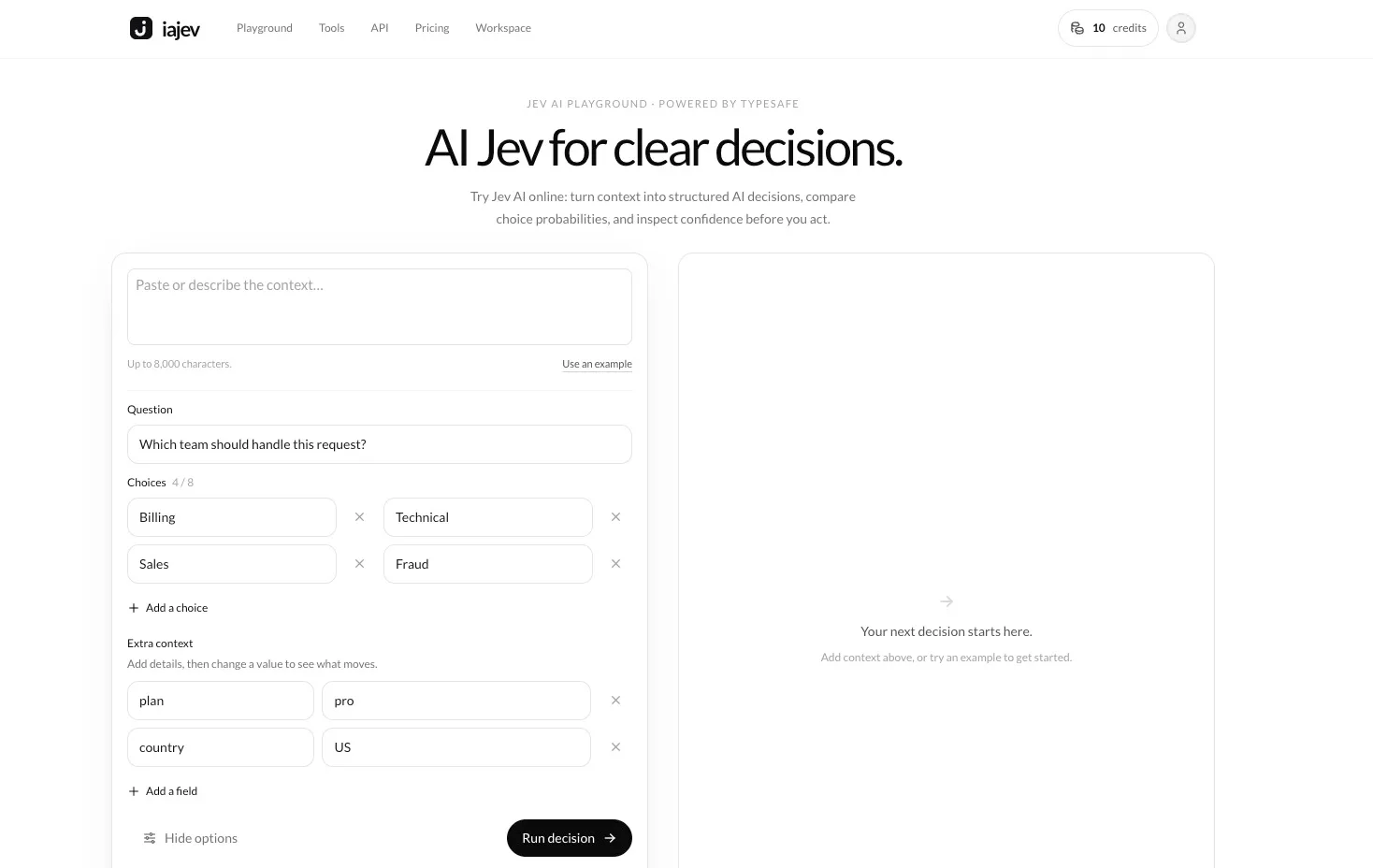
AI Jev is a System One decision model designed to turn unstructured context into structured choices with probabilities and confidence scores. Instead of generating open-ended text, AI Jev focuses on bounded, well-typed decisions inside software such as ticket routing, lead qualification, intent detection, and tool selection. Through the iajev playground and Decisions API, you can send context, define possible outcomes, and receive a JSON response with the selected choice, per-choice probabilities, and an overall confidence signal.
How to use AI Jev
-
Describe your context in the playground
Open the AI Jev playground on iajev and paste the relevant information into the “Context” area. This can be a support ticket, a customer message, CRM fields, a plan, country, budget, or any facts that matter to the decision. The playground supports up to roughly 8,000 characters of context. -
Define the question and choices
Use one of the ready-made tools or define your own decision. In the “Question” field, describe what you want the model to decide, such as “Which team should handle this request?”. Then add 2–8 text-based choices that represent the possible outcomes, for example “Billing”, “Technical”, “Sales”, and “Fraud”. -
Run a decision in the browser
Click “Run decision” to send your context, question, and choices to AI Jev. The playground will display the chosen answer along with a probability distribution over all choices and an AI confidence value. You can inspect the structured JSON output to understand how the decision is represented programmatically. -
Experiment with examples and what‑if scenarios
Try prebuilt examples like routing a support ticket, classifying customer feedback, detecting user intent, selecting an AI agent tool, or qualifying a sales lead. Modify the context while keeping the same question and choices to see how probabilities shift. Use the “Before → After” and “What if…” views to compare two runs and understand how additional fields (plan, country, budget) influence the decision. -
Set up API access with an iajev key
Create an iajev account, add credits, and generate an API key in account settings. Use this key as a Bearer token when calling the Decisions API. Each API call sends a JSON payload with astateobject for context and adecisionobject describing the question, decision type (such aschoice), and list of choices. -
Call the Decisions API from your backend
From your server (for example using cURL, Python, Node.js, Go, or Java), send an HTTPS POST request to the AI Jev decisions endpoint. Include headers forAuthorizationand a uniqueIdempotency-Key, and a JSON body with your context and choices. Parse the JSON response to read the selected choice, per-choice probabilities, confidence, and latency. -
Integrate AI Jev into your workflows
Use the returned choice to drive downstream actions in your product. For support, map each choice to a team or queue. For sales, map a “Hot / Warm / Cold” category to follow-up logic. For agents, let the selected tool name determine the next function to call. Because the output is typed and probabilistic, you can set thresholds or fallbacks based on confidence. -
Benchmark and refine your decision model
Collect labeled examples from your own workflows and run them through AI Jev to measure accuracy, latency, and reliability. Compare the predicted probabilities with real outcomes to assess calibration. Adjust your context fields, choice design, and automation rules before rolling decisions into production.
AI Jev's use case
-
Support ticket routing and categorization
Direct incoming support messages to the right team, such as Billing, Technical, Sales, or Fraud, based on message content, plan, region, and user history. Improve first-response speed by automating routing while still allowing human agents to oversee edge cases and low-confidence predictions. -
Customer feedback classification and sentiment analysis
Categorize feedback into bug reports, feature requests, praise, or questions, and assign sentiment labels such as positive, neutral, negative, or mixed. This helps product and support teams prioritize fixes, track feature demand, and monitor customer satisfaction in a structured way. -
User intent detection and journey optimization
Interpret what a user is trying to do—buy, get help, cancel, or learn more—from short messages, chat transcripts, or forms. Route them to the correct funnel step, content, or agent queue, improving conversion rates and reducing friction in self-serve flows. -
Sales lead qualification and scoring workflows
Classify leads into qualitative buckets like Hot, Warm, or Cold using message content, plan type, geography, or firmographic data. Sales teams can then prioritize outreach, design cadences, and report pipeline health with consistent, model-driven categories instead of ad‑hoc rules. -
AI agent tool selection and automation orchestration
In agentic systems, use AI Jev to choose the next tool to call—such as Search, Calculator, Code, or Database—based on the current state and user request. The model’s probabilities and confidence help you decide when to proceed automatically, when to chain multiple actions, and when to defer to human review.
Benefits of AI Jev
-
Structured, probabilistic decisions instead of open‑ended text
AI Jev is purpose-built for decisions over defined outcomes, returning a clear choice plus a probability distribution and a separate confidence score. This structure simplifies downstream logic, auditing, and monitoring compared with free-form text generation. -
Calibrated decision focus with RLCD training
The model uses Reinforcement Learning for Calibrated Decisions (RLCD) to better align predicted probabilities with correctness. This focus on calibration helps teams reason about risk, set confidence thresholds, and design safety nets for automation in sensitive workflows such as verification and moderation. -
Flexible integration across languages and frameworks
Because AI Jev is exposed via a JSON-based HTTP API, it works with Python, JavaScript/TypeScript, Go, Java, Rust, and more without requiring a dedicated SDK. It can plug into web frameworks, serverless backends, or agent frameworks through simple HTTP adapters or custom tools. -
Transparent playground for experimentation and comparison
The iajev playground lets you interactively test real decision workflows, inspect raw JSON responses, and compare runs as you tweak context fields. This visibility makes it easier to debug decisions, explain outcomes to stakeholders, and benchmark Jev against alternative models. -
Designed for classification, routing, and business automation
AI Jev is tailored to common business tasks such as ticket routing, lead qualification, risk triage, verification, and content moderation. With customizable choices, you can model approve/reject/review flows, low/medium/high risk decisions, and other operational policies while keeping humans in the loop where needed.
Pros
- Focused on structured choice decisions with probabilities and confidence, ideal for routing and classification.
- Simple JSON over HTTP API that works with many programming languages and frameworks.
- Interactive playground for rapid experimentation with real contexts and ready-made templates.
- RLCD-based training emphasizes calibrated probabilities for more reliable automation design.
- Supports wide-ranging use cases from support and sales to agents, verification, and risk.
Cons
- Requires you to design and maintain your own choices and benchmarks; no turnkey vertical models.
- Not intended for open-ended content generation like general-purpose chat LLMs.
- Pricing is credit-based, so heavy usage requires monitoring token consumption and thresholds.
- Lacks native SDKs or connectors for popular frameworks, relying instead on custom HTTP integrations.
Help more people discover your product.
Submit to Submito