What is The Audio Stuff
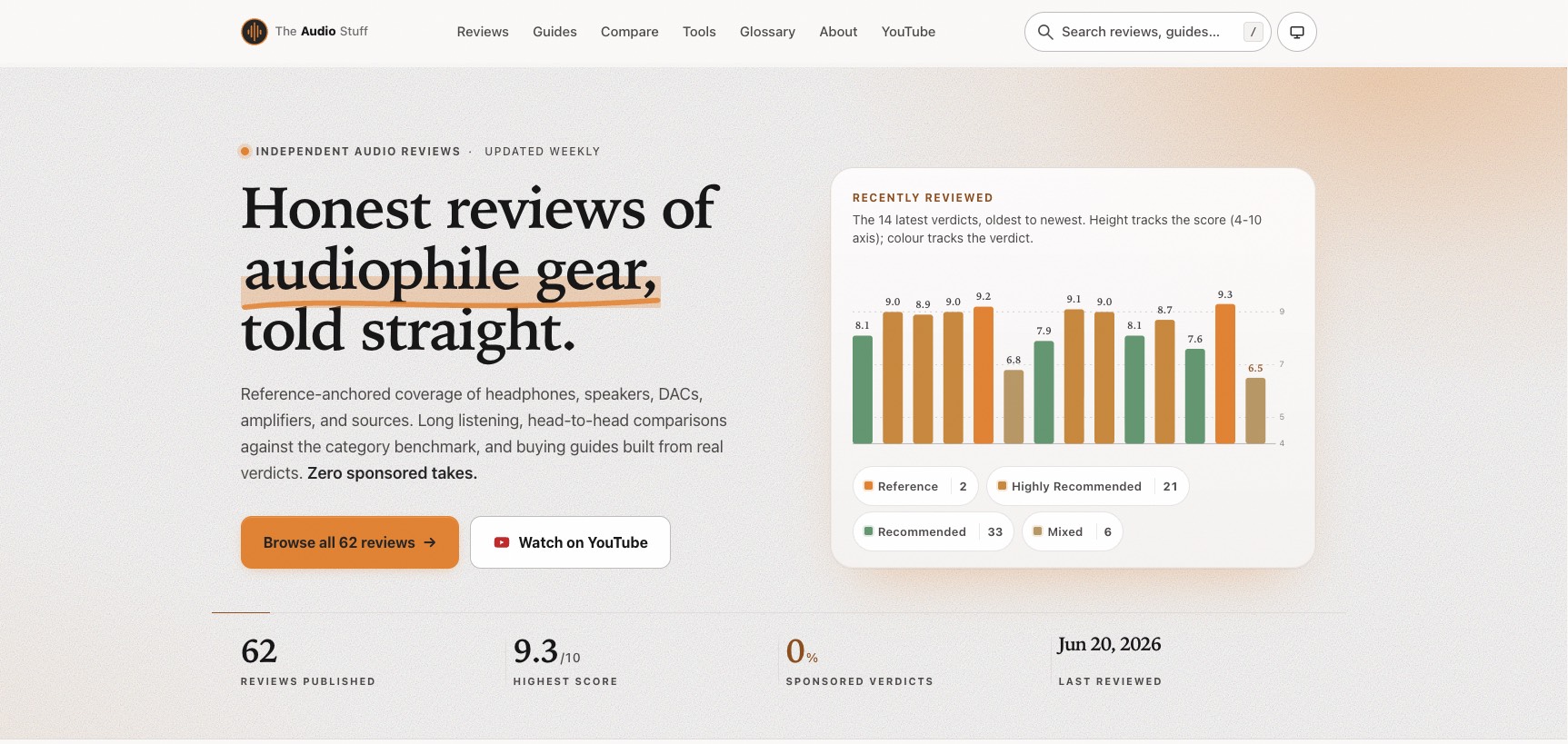
The Audio Stuff is an independent audiophile review platform focused on honest, reference‑anchored testing of headphones, speakers, DACs, amplifiers, sources, and accessories. Every piece of gear is evaluated over weeks on a fixed reference chain, scored on a 0–10 scale, and compared head‑to‑head against published category benchmarks. The site also offers curated buying guides, direct A/B comparisons, and browser‑based audio tools, all built around transparent methodology and zero sponsored verdicts.
How to use The Audio Stuff
Browse the latest reviews
Start on the homepage to see the most recently reviewed products, their scores, and one‑word verdicts (Reference, Highly Recommended, Recommended, or Mixed). Click any product card to open the full review with detailed listening notes, measurements context, and scoring breakdown.Navigate by category
Use the “Reviews” navigation menu to jump into specific categories such as Headphones, Speakers, DACs, Headphone Amps, Speaker Amps & Preamps, Sources, or Accessories. Within each hub, filter and scan reviews by score, verdict tier, and price tier to find gear that fits your system and budget.Leverage buying guides
Open the “Guides” section to access curated shortlists like “Best DAC Under $2,000” or “Best Open‑Back Headphones.” Each pick in a guide links back to its full scored review, so you can read the in‑depth verdict behind every recommendation instead of generic “top 10” filler.Compare products head‑to‑head
Go to the “Compare” section to see tightly matched A/B showdowns between similar products (for example, two headphones or two speaker amps). Read how each piece performs on the same chain and reference recordings, then use the explicit score gaps to decide which one better fits your priorities.Use the free in‑browser tools
Visit the “Tools” hub to run audio utilities directly in your browser. Examples include a “Help Me Choose” finder that builds a ranked shortlist from scored reviews, a Headphone Power Calculator, an ABX Blind Test, a Hi‑Res Fraud Detector, a Room Modes visualizer, and an EQ simulator. Follow on‑screen prompts for each tool; no signup or upload is required.Understand the reference chain and standards
Explore pages like “How we test” and “The reference chain” to learn exactly how scores are built. Read about the fixed reference rig (DAC, amp, headphones, speakers, transport, power conditioning) and the international standards cited for listening tests, measurements, loudness, and headphone/speaker evaluation.Watch reviews on YouTube
Click through the “YouTube” link to watch video versions of the reviews, including long‑form listening sessions, A/B comparisons, and featured gear teardowns. Use these alongside the written pieces to get a fuller sense of how each product performs and sounds.Contact the team or submit gear
Use the published email or messaging links on the “Contact” page if you want to submit gear for review, ask methodology questions, or flag a potential error. The team publishes corrections and disclosures based on the same scoring rubric they use for gear.
The Audio Stuff's use case
Audiophiles choosing their next upgrade
Enthusiasts looking to buy new headphones, speakers, DACs, or amplifiers can rely on The Audio Stuff’s reference‑anchored scores and detailed listening impressions to make confident purchase decisions without marketing spin.Buyers comparing closely matched gear
Users torn between two or more similar products can read the dedicated comparison articles and score gaps, all based on same‑chain, same‑recording tests, to understand real‑world differences in tonality, technicalities, and value.Listeners building or optimizing a full system
People assembling a complete audio chain – from digital source to power conditioning, DAC, amp, and transducers – can use the reference chain descriptions, category hubs, and buying guides to choose components that work together coherently.Beginners learning audio terminology and best practices
Newcomers to hi‑fi can use the site’s glossary, measurement explanations, and standards references to understand concepts like LUFS, Spinorama, R‑2R vs delta‑sigma, room modes, and headphone target curves, helping them read reviews more critically.Room and system tuners
Users trying to improve their current setup’s sound quality can employ the free tools (e.g., Room Modes visualizer, EQ simulator, ABX Blind Test, Hi‑Res Fraud Detector) to diagnose issues, test changes, and validate whether they truly hear differences.
Benefits of The Audio Stuff
Independent, unsponsored verdicts
The Audio Stuff emphasizes that no verdicts are sponsored and brands have zero editorial input. This reduces bias and gives readers confidence that scores and recommendations are driven by performance and value, not ad spend.Reference‑anchored, cross‑category scoring
Every product is compared against a published reference list within its category and price tier. This approach means a 9.0 on a headphone is calibrated to carry the same weight as a 9.0 on a DAC or amplifier, making scores more meaningful across the entire chain.Long‑term, real‑world listening
Reviews are based on weeks of daily use across multiple sources and genres, not quick demo‑room impressions. This extended listening window helps surface strengths, weaknesses, and system‑fit considerations that short tests often miss.Transparent methodology and standards
The Audio Stuff openly cites international standards and key industry research for listening tests, loudness, measurements, and headphone/speaker evaluation. Readers can see exactly how tests are run and why certain protocols are chosen, improving trust and repeatability.Integrated tools and guides
Beyond reviews, the site provides structured buying guides, direct comparisons, and practical browser‑based tools. This ecosystem helps users move from research to decision to fine‑tuning in one place, streamlining the entire upgrade journey.
Pros
- Clear, reference‑anchored scoring that stays consistent across categories and over time
- No sponsored verdicts, with strong editorial independence and explicit disclosure practices
- In‑depth, long‑form listening impressions anchored by a fixed reference chain and standards
- Useful ecosystem of buying guides, head‑to‑head comparisons, and in‑browser audio tools
- Transparent methodology that cites recognized industry and international standards
Cons
- Limited total number of reviews compared to large commercial publications
- Focused on audiophile‑grade gear, so some mainstream or mass‑market products may be absent
- Scores and impressions reflect the site’s specific listening preferences and reference chain
- Deep technical and methodological detail may feel overwhelming to casual buyers
- Availability and pricing of reviewed gear can vary significantly by region and over time